


What Can Be Sampled?
Numerous aspects of government operations can be the subject of performance audits. These audits often focus on the management of specific programs and services or the implementation of policies and regulations. Because of the varied topics covered by performance audits, there is a wide range of opportunities for sampling. Commonly sampled items (called sampling units) in performance audits include, for example:
- program files, project files, personal files (personal files can include health care files, education files, immigration files, taxpayer files at the revenue agency, etc.)
- people (employees, managers, clients, contractors, stakeholders, etc.)
- transactions (financial transactions, contracts, sales, purchases, etc.)
- locations (service-delivery locations, schools, health care institutions, embassies, etc.)
- equipment (airplanes, trucks, ships, computers, medical devices, etc.)
Over the course of a year, audit institutions will often need to assess samples in many different categories. For example, in the 2018 reports of the Office of the Auditor General of Canada, a variety of samples were used to draw conclusions. The sampling units in these samples included many personal files (detainee cases, offender parole cases, and tax files), locations (foreign affairs missions), program files (military justice cases), and project files (asset disposal decisions).
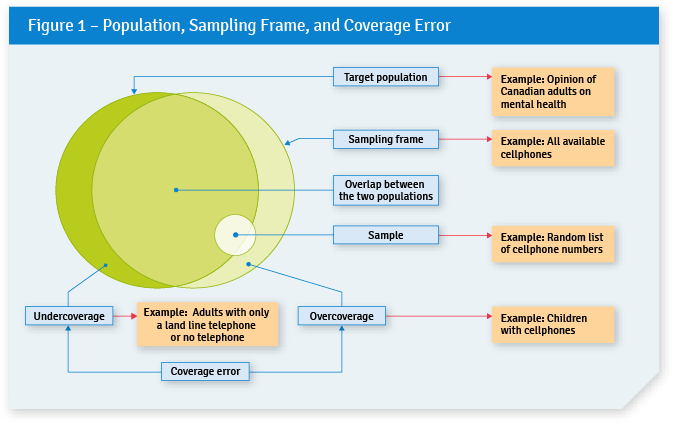
A sample is always taken from a target population. This target population can be extracted from a project database, a human resource database, a client list, or any similarly organized record. In some instances, a sample can also be extracted while conducting an inspection or a site visit (e.g., in an audit of public transit, stopping every fifth passenger to ask them questions about their user experience). A full extract can be performed or, alternatively, a selective extract can be obtained based on clearly stated parameters depending on the audit scope or audit objective. For example, parameters can be defined to select only projects with values between $1 million and $10 million, or service beneficiaries between 18 and 30 years old, or transactions conducted in the first quarter of the 2019–20 fiscal year. Once a target population is defined, a sampling frame can be developed.
The sampling frame is a list of the items in the population. Although ideally a sampling frame is the same as the target population, there may be a difference between them due to inaccuracies in the database, the absence of unique identifiers, out-of-date information, or other factors. This difference is called a coverage error. Figure 1 illustrates these concepts for a study on the opinion of Canadian adults about mental health issues. A coverage error arises because a part of the population does not own a cellphone and is not included in a sampling frame based on a random list of cellphone numbers.

 LinkedIn
 Twitter