


Homogeneity and Heterogeneity
Homogeneity is the level of uniformity among sampling units within a population. Homogeneity is commonly interpreted as meaning that all the items in the sample are chosen because they have similar or identical traits (for example, people in a homogeneous sample might share the same age, location, or employment). However, the mathematical meaning of homogeneous is that a data set can be analyzed mathematically and is operating under the same rules and constraints.
The more homogenous a population, the more valid the conclusions drawn from a small sample. Lack of homogeneity, known as heterogeneity, within a population can have a major negative impact on the interpretability and validity of results obtained from a sample. When a population is heterogeneous, there is a higher likelihood that a single sample will not reflect the complexity of the population—that is, important characteristics may be misrepresented or ignored.
For this reason, assessing the heterogeneity level in a population is a key step in the sampling process, for both generalizable sampling and purposeful sampling. As a general rule, when dealing with a heterogeneous population, the population should be divided into as many groups as necessary to ensure that each subgroup is sufficiently homogeneous for the sampling purpose as defined by the audit objective and scope.
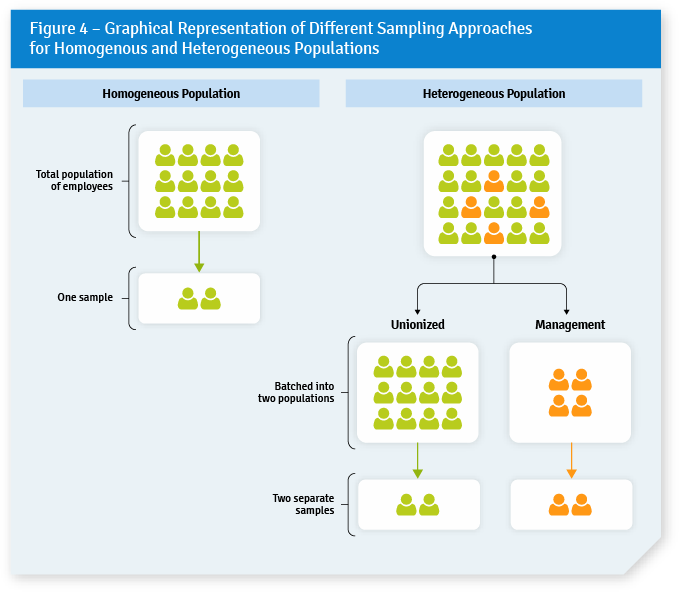
Two examples in Figure 4 illustrate the importance of understanding whether a population is homogenous or not. In the first example, the context is a hypothetical survey of employees of a government department about the adequacy of water and air quality in their work environment. Because the employees all breathe the same air and drink the same water, they form a homogenous population and, in that case, a single sample would therefore be sufficient. In the second example, the survey is about management style in the department. Because some employees are part of management and others are unionized, there are two distinct groups of people (two populations) that may have very different opinions about management style in the department. In this instance, it would therefore make more sense to take two separate samples, one from each population.
Assessing a population’s level of heterogeneity is a difficult initial step to take and is often conducted with little firm data. In some instances, auditors may not even have the information to assess the degree of heterogeneity in a population. For example, the analysis in Figure 4 would not be possible if personnel data broken down between unionized staff and management was not available.
Heterogeneity always increases both the cost and complexity of any audit, because more samples and sampling approaches could then be required to complete the audit work. Also, because it is unlikely that any population or subpopulation will be perfectly homogenous, audit teams have to judge the amount of acceptable heterogeneity based on their audit objective and scope.
Ultimately, auditors have to be comfortable that each subgroup they create is made up of reasonably similar units (in terms of materiality, risk, population characteristics, or other parameters relevant to the audit objective) that can be analyzed in the same manner.
More information on how to assess and optimize the homogeneity of populations is in Part 2 of this guide.

 LinkedIn
 Twitter